§1Why I flipped my math classroom in 2012
I started flipping my math classroom in 2012, at Barstow High School, in the high desert of California. I want to be precise about that year, because most of the press coverage about me reports later dates — 2014, 2015, sometimes 2016. Those are the years the news started showing up. The work itself started in 2012.
Here's what was happening that year. I was teaching algebra, precalculus, AP Calculus, and AP Statistics — four preps. I was also finishing my doctoral coursework. And I was watching my AP Stats students get crushed by the AP exam every May. In 2009, my first year teaching it, exactly one of my students passed.
I was lecturing the way I had been taught to lecture. I would stand at the board, work problems, ask questions, and watch the same five students nod while the rest stared. The students who got it didn't need me; the students who didn't get it weren't getting it from a one-shot, in-the-moment explanation either. The mismatch was obvious. I just didn't have a fix.
I'd seen Khan Academy by then, and a few other math channels. The idea of recording lectures was in the air. What I didn't have was someone telling me whether it would work in my classroom, with my kids, on my schedule. So I started recording. Camera in front of a small whiteboard, lessons posted to YouTube the night before class, problem sets the next day in class. That was 2012.
In 2013, the schedule changed at Barstow High. Class periods got cut from sixty minutes to fifty. Ten minutes doesn't sound like much until you try to teach calculus inside it. The new period length killed any chance of lecturing and practicing in the same class. The flipped model, which had already been running for a year, suddenly looked less like an experiment and more like the only way the math was going to fit.
The local press caught on before the wider news cycle did. The Daily Press in Victorville ran a piece in November 2012 about a Barstow High math website that was being shared with educators around the district, and a profile in December that walked through what I was doing in the classroom. Two articles within six weeks, both inside the calendar year the work began. The international-recognition piece followed in November 2014. By then, other teachers in the district were already sending me messages. The Apple Distinguished Educator Institute in Berlin asked me to talk about it in 2016. The Asian Journal showed up with a reporter in 2018, the same year the Daily Press ran a follow-up titled "Flipping the Script." The Silver Play Button arrived in 2023. None of that is why I flipped. I flipped because I had four preps, fifty-minute periods, a doctoral dissertation, and one AP Stats student passing the exam. I needed a system that would let me actually help the students who needed help. Recording the lectures was the only way I could think of to free up the class time.
The first try: thirty minutes of nothing
Before any of that worked, there was a false start. My very first attempt was in 2009. I had watched a Brian McLogan math video on YouTube and thought, I can do that. I set up my Canon camera, sat on a bar stool in Room 30 of my Barstow High classroom, hit record — and stared at the lens for thirty minutes. Nothing came out of my mouth. Nothing.
If you have never recorded yourself teaching, it is awkward in a special way. You forget how words work. You feel the camera judging you, and somehow your students judging you, before you have published anything. I kept that first clip, because every teacher who is confident on camera now started exactly there.

My very first try at recording a lesson · Numberbender · thirty minutes of nothing — me, my Canon, and a wall of awkward
I made ten videos that first time and then said it out loud: this is not for me. I was spending hours on twenty-minute AP Stats videos that almost nobody watched, not even my own students. One of them had nine views. When I came back to it in 2012, two things made it stick: a much faster way to record, which I describe in section four, and a different way of thinking about who was watching.
Here is the second one. We get so caught up imagining the thousands of people who will bash our video that we forget we don't have a single follower yet. Focus on your automatic subscribers instead: the thirty students sitting in your room. They will watch, because it is their assignment. Once you stop carrying an imaginary crowd of critics, the words start coming out and the camera stops being scary. Your first ten videos will not be your best work. Mine weren't. Your eleventh might change how you teach.
§2What "flipping" actually means in a math class
There is a textbook definition of flipping the classroom that I have never used. Mine is closer to what I told a faculty audience at De La Salle University in Manila in 2017: a flipped classroom is one where students watch and complete the lecture material on their own time, and use class time to work on problem sets with the teacher and their classmates.
That's it. There is no app required, no platform, no special license. It is a rearrangement of when the lecture happens and when the practice happens.
Here is the version that helped my colleagues understand it. Tuesday before flipping: I lecture for thirty-five minutes on the chain rule, then assign fifteen minutes of practice. Some kids start the practice in class, most start it at home. The kids who get stuck at home stay stuck until Wednesday. By Wednesday, half the class has the wrong intuition glued in.
Tuesday after flipping: students watch a six-minute video Monday night that walks through the chain rule with two worked examples. Tuesday they walk in already exposed to the idea. The full fifty minutes is spent on practice — mixed problems, error-finding, peer explanation, and me circulating with my pen and a clipboard, sitting next to whoever is stuck. By the time the bell rings, I've talked to every student who is struggling.
That is the difference. The lecture is the cheap part. The expensive part is what happens when a student is in the middle of working a problem and can't figure out the next step. That moment is where the learning lives, and that moment used to happen at the kitchen table with no one around. Flipping moves it back into the room with the math teacher in it.
§3The first math unit you should flip
If you have not flipped a unit before, do not flip the whole course. Flip one unit. Pick the one you teach worst.
The unit you teach worst is usually the one where you have already given up on the lecture working — where you know, before you start, that half the class is going to be lost by Wednesday. For me, the year I started, that was solving systems of equations in Algebra 1. Not because the math is hard, but because there are several different methods and students need to choose the right one for the right problem. You can't lecture your way into that judgment. You have to coach it, problem by problem.
That is the unit to flip first. Record short videos for each method — substitution, elimination, graphing — five to ten minutes each. Have students watch them at home. Then spend every minute of class time having them choose a method and defend the choice. The lecture becomes the warm-up. The class becomes the gym.
Two reasons to start with your weakest unit. First, the upside is the highest. If your usual lecture-and-pray approach gets you a sixty percent pass rate on that unit, anything that gets you to seventy is a win. Second, you'll find out quickly whether flipping suits your teaching style. If it doesn't work on the unit you teach worst, it won't work anywhere. If it does work — and in my experience it usually does — you've already proven the model in the place it was hardest to prove.
Don't pick a unit you love. Don't pick the one where you have a beautifully timed twenty-minute story-lecture you've been giving for years. That lecture is good. The class is enjoying it. Flipping it would feel like demolishing a perfectly good kitchen. Flip the kitchen that's already broken.
§4How long math videos should actually be
Most of my videos are between five and ten minutes. A few are shorter; almost none are longer. That length is not an accident, and it is not a YouTube best-practice I read in a blog post. It is what I converged on after recording for three years and watching what students actually finished.
I want to be honest about what it felt like in the beginning, because nobody told me and I wish they had. The first videos were hard. It felt awkward talking to a camera instead of a room. The videos ran too long. The workflow was inefficient. A five-minute finished video could take me close to an hour — and in those early months, I still had no idea whether any of it was working. I was finishing my doctoral coursework on the side. I was not sleeping enough. And the videos were getting better slowly, but not nearly as fast as I needed them to.
What changed everything was a YouTube video by Dr. Lodge McCammon on what he calls the FIZZ method. The approach is simple: use a whiteboard or handwritten notes, and film in one take. No elaborate retakes, no heavy editing — write it out, say it once, done. That was the breakthrough I needed. Once I stopped treating every recording as a production project and started treating it as a spoken version of my own notes, the ratio flipped. I was able to record efficiently enough to flip four different classes in two languages and stay ahead of the calendar.
The other thing I discovered, almost by accident, was that writing the lecture out on a whiteboard or a sheet of notes before recording was both my script and my rehearsal. Because I was writing my own explanation, my brain was already organizing what to say and in what order. By the time I pressed record, I had already rehearsed it once, in the act of writing. That gave me confidence. It made the one-take approach work. And it is the same method I would recommend to any teacher starting out today.
Here is the production math, paraphrased from a quote of mine that ran in the Asian Journal in 2018: each ten-minute clip took me about an hour to make. I had to write the lecture out on a whiteboard, film it, edit it, and upload it. An hour for ten minutes of finished video is roughly a six-to-one ratio. If you are flipping a unit with twelve concepts, that is about twelve hours of recording and editing. Plan for it.
Here is the watch-time math, from looking at my own analytics. A six-minute video on a single concept gets watched all the way through. A twelve-minute video on the same concept gets watched for the first four minutes and then closed. The drop-off is sharp, and it is the same students dropping off in both cases — not the strugglers, the everyone. Long math videos are an attendance problem.
You can check this yourself. YouTube Studio shows an audience-retention graph for every video — the share of viewers still watching at each second. On my early twelve-to-fifteen-minute videos, the curve fell off at the same place almost every time, around the four-to-five-minute mark. Students weren't lazy. I had kept them past the point where they had what they came for. The drop-off point is the most honest feedback on your teaching you will ever get, because students won't tell you. They'll just stop watching.
The rule I use now is one concept per video. If a topic has three sub-concepts, that is three videos, not one twenty-minute marathon. Each video is short enough that a student who has to rewatch a section can rewatch it without paying the cost of scrubbing through ten minutes of stuff they already know. The rewatch is what makes the model work. Long videos kill the rewatch.
Name the parts so students can find them: "Factoring by Grouping — Part 1: Setting Up the Groups" and "Part 2: Completing the Factor." A student who gets Part 1 the first time skips straight to Part 2. A student who needs Part 1 again rewatches just that. And if a concept fits in under five minutes, even better.
A short note on production. Don't put a lot of work into the first thirty seconds of intro — no music, no "hey, what's going on, guys." Students aren't on YouTube to be entertained; they have a problem due tomorrow. The first five seconds should already be the lesson. State the topic, do the math, say a sentence about why it matters, and stop. The video below is one I recorded years ago about how I make these tutorials in the first place. It's not pretty, but the workflow it shows is the same workflow I'd recommend today.

How To Make a Video Tutorial in YouTube · Numberbender · the production workflow this section is describing
§5What to do with class time when the lecture is gone
This is the part of flipping that nobody warns you about. The first day after you've moved the lecture out of the classroom, you walk in with a fifty-minute period in front of you and no plan for filling it.
You do not, under any circumstances, give the lecture again "just to be safe." That defeats the entire model. Students will figure out within a week that the videos are optional, and you'll be back to where you started, except now you've added an hour of evening recording work to your schedule and earned nothing for it.
What I do instead, in roughly this order. I open with a one-minute warm-up problem on whatever was in the previous night's video, just to confirm who watched it. I take the answers out loud, by show of hands or whiteboard, and I make a quick visual map of who got it and who didn't. That takes five minutes. Then I hand out a worksheet of mixed problems on the unit so far, and I circulate. I sit down next to students who are stuck. I ask them to talk me through the step they're on. I correct one thing, then I move. I get to maybe a third of the room each period. The other students help each other.
The Metro.Style piece in 2019 mentioned something about this model that I had not noticed myself. SPED students, and students who couldn't afford private tutors, were using my videos in ways I hadn't planned for. The video on YouTube doesn't care how slow a student needs to play it back, doesn't care if they pause it three times to look up a word, doesn't charge by the hour. The class time, freed up, gave me the bandwidth to actually sit with those students. Both halves of the model — the asynchronous video and the synchronous class — were doing something the old lecture couldn't do.
Class time, post-flip, is also where you find out who hasn't watched the video. The students who didn't watch are the ones who can't start the warm-up. You don't have to ask them. The room tells you. The follow-up is a private conversation, not a class-wide guilt trip. You ask what got in the way, you suggest watching during lunch, and you keep moving. The model is not built on enforcement. It is built on making the asynchronous version more useful than not watching.
If your class still opens with ten minutes of review, you haven't redesigned it. The students who watched sit through review they don't need, and the ones who didn't are still lost. Start with the thing the lecture was always the barrier to: a harder problem set, an error-finding task, a peer explanation, a group problem that needs the idea from the video. The warm-up is a diagnostic, not a review.
And no, you don't teach less. I work harder in a flipped class than I ever did lecturing, but it is the good kind of work. You become a coach instead of a lecturer, and the student who used to zone out in row four is someone you finally have time to sit next to.
The performance gains in the 2016 randomized controlled trial (n = 91, p < .05) came from a model where class time was fully redesigned for collaborative problem-solving and teacher-facilitated application — not from video production alone. The control group had a competent teacher. The difference was what happened during the session.
Esperanza, P., Fabian, K., & Toto, C. (2016). Springer LNCS Vol. 9891.§6The mistakes I made (so you don't have to)
In 2012 I did not ease into it. I flipped four preps at the same time — four video libraries built from scratch — while finishing my doctoral coursework. There is a quote of mine in the Asian Journal profile from that period: I had no social life, I was finishing my dissertation, and it was all worth it. The work was worth it. The approach — flip everything, sleep later — was not the only way to get there, and I wouldn't recommend it to anyone. These are the five mistakes I'd warn a colleague about, each with its fix.
1. Flipping everything at once
The production load was brutal, but the real problem was that I had no feedback loop. When you flip one unit, you find out within a few weeks which videos run long, which concept needs two videos, which accountability routine students ignore — and you fix it. When you flip four courses at once, you produce a semester of videos before you have learned anything from the first ten, and you're committed to a library built on your least-refined instincts.
The fix: flip one unit in one course — the one you teach worst, per section three. Adjust the video length, the class routine and the accountability loop. Then flip the next unit. The pace that feels slow is actually faster.
2. Videos that were too long
My first videos ran twelve to fifteen minutes, sometimes more for optimization or related rates, because that was how long a chunk of my live lecture ran. The retention graphs dropped at four to five minutes on almost every one. A twelve-minute video isn't one lesson; it's three or four sub-concepts crammed into one container, and a student who gets confused on the second one at 11 p.m. on a phone doesn't scrub back to find it. They stop.
The fix: one concept per video, five to ten minutes at most. If you reach the eight-minute mark and you're not done, it's two videos (section four).
3. Treating the flip as content delivery
For the first couple of months I measured success by uploads. I had a spreadsheet. What I didn't track was what was happening to class time, and I was running class exactly as before: review, a few examples on the board, then practice. All I had done was move the boring part of class into the evening and keep the boring part of class in the morning.
The fix: design the session from scratch so it assumes preparation and moves straight into application (section five). The video is the easy part. The model lives or dies on class time.
4. Assuming students would watch
Some didn't, and I reacted badly. I made it punitive with a daily quiz on the video. Students resented it, and the ones who weren't watching either kept not watching or played the video in the background while doing something else. For most of them the barrier wasn't attitude. It was a job, younger siblings to look after, or a phone with no data plan. I had diagnosed a structural problem as a discipline problem.
The fix — and this is the secret: grade the notes, not the watching. A quick look tells me whether a page of notes earns zero, five or ten points. In high school I walked the room during the warm-up and checked handwritten notes on the spot; I could cover everyone in five minutes. In college, students upload a photo of their handwritten notes to Canvas before class, and the grade is a two-second decision. Students who take notes while they watch are processing the math, not scrolling past it.
The first time I caught a student copying a classmate's notes, I panicked and thought the whole system would collapse. It didn't. Even the student who copies is reading and writing what the video taught. Compare that with copying homework answers in a lecture class, where nobody ever sees the steps. In a flipped class, even the cheating teaches.
5. Teaching the math the way I learned it
This one hid behind competence. My videos were accurate and clear — to me, and to students who were already halfway there. I skipped verbal setup steps that felt obvious, used notation shortcuts, and said "and as you can see" where a struggling student could not see. I had simply moved the moment I lost them from the morning to the evening. My own rewatches never caught it, because I knew what I meant.
The fix: before you post, ask a student who usually gets lost the first time through to watch it and answer one question: "Tell me the first moment you got confused." Re-record from that point. Try it with a second student. By the third version the video is shorter and clearer, because you've cut the parts that only made sense if you already knew the math. I've worked this way since about year three, and nothing improved the channel more.
The smaller mistakes
These fix themselves eventually, but they can cost you a week. File names: I lost hours hunting for "Algebra Unit 3 Video 4 final FINAL v2 USE THIS ONE.mp4." Name every file with the date, course, unit and concept — something like 2026-09-14_A1_U3_factoring-gcf.mp4. Thumbnails: they don't need to be fancy, but they should look like they belong together so students can scan a playlist. The wrong video: once, the night before a quiz, I posted a rough take with a math error in it. Keep a simple log of what you've posted, and check the link, not just the file name.
If you're in year one, don't quit
I almost went back to lecturing during my first year of flipping. I listened to that voice for about a week and a half before my gut told me to push through, and it was the best decision of my career. Year two is easier than year one. By year three you'll wonder why anyone goes back. Every one of my classes is still flipped today.
It still isn't always smooth. The marker dies mid-sentence, the dog barks during the take, and once in a while the whiteboard slider tries to take me out. Flipping a math class takes practice, patience and a willingness to laugh at yourself.

Behind the scenes: recording a calculus lesson · Numberbender · even Apple Distinguished Educators get head-butted by the whiteboard

How I Flipped My Classroom in Barstow High School · Numberbender · the model in retrospect, in my own words
§7Flipped classroom in hybrid and fully online courses
When schools closed in March 2020, most teachers were putting their lectures on video for the first time. I had eight years of math videos on YouTube already, and a classroom model built on the idea that the teacher's voice doesn't have to come from the front of the room at a fixed time of day. Distance learning didn't break the flip. It showed, more clearly than ever, which parts of it were doing the work.
That year, Vibal Group, one of the Philippines' leading educational publishers, asked me to give a webinar for Filipino teachers on flipping in a fully remote setting. Many of them taught in provinces with unreliable signal, with one device shared between three siblings, so the version I described was the minimum that still works under those conditions. My argument was that distance learning and the flipped classroom are close relatives. The teachers who struggled most in 2020 weren't the ones without equipment; they were the ones whose teaching identity was built around the moment of delivery. Flipped teachers knew what was left when the room disappeared: the follow-up, the targeted help, the application. You can watch The Power of Flipped Classroom in Distance Learning on Facebook.
What distance learning did stress was the in-class session — the warm-up, the circulating, the moment you catch the student who got lost at step two. Zoom breakout rooms, polls and shared whiteboards can approximate it, but only when everyone has a working connection at the same time. What it did not break was the video. Watch data on my channel through 2020 and 2021 showed more rewatching, not less; without a room full of peers, students were more willing to replay a section three times than to raise a hand. The flip isn't all-or-nothing. A partly realized flip still beats a lecture that assumed learning ended when class did.
How I run a fully online flipped class
I teach at Barstow Community College now, and a chunk of my load is online or hybrid. In a fully online math class, the videos do most of the heavy lifting, so the redesign moves into your discussion structure and your live sessions. I post the videos by topic, add a worked-example walk-through students can follow at their own pace, and run live sessions twice a week where students bring the problems they're stuck on. The live session is the equivalent of the freed-up class period: mostly me sharing my screen, working a problem somebody asked about, and asking the room what they would have done differently.
Design the live session around what the video couldn't do. If your Zoom session is you re-explaining the video, the model has failed. Open with a quick warm-up that assumes they watched, then move straight into application, error analysis and one-on-one help in breakout rooms. For the live part, my Teach It Like You Stream It framework and the free Numberbender Studio app are how I keep students looking at a person and the math at the same time.
Require handwritten notes, and grade them. I've done this since 2012 and still do it in every online course. Watch history is easy to fake: press play, put the phone down. A page of handwritten notes on implicit differentiation is not. Students upload a photo before the session, I scan them in about thirty seconds, and I can see who engaged and where their thinking is. Writing math by hand also slows students to the speed the math requires — they pause, rewind, and write the step before moving on. That isn't a side effect of notes. It's the point.
If the course is asynchronous only, build in fast feedback. Videos and notes support independent learning, but students still need to find out right away when they've gone wrong. I use Cerebry, an adaptive learning platform, for the problem sets. Students must answer each question correctly before moving on, and a wrong answer brings up a written, step-by-step solution they have to work through. Each topic has three levels worth 10 points each, so full credit means showing mastery level by level — and there's no copying a neighbor's answer. Without something like that, an asynchronous flip is a pile of videos: a textbook with a play button.
In a hybrid class, the model is closer to its original form. Students watch the videos before class, and the in-person time is for problem sets and one-on-one help. What surprised me, working with adult learners, is how fast they take to it. A community college student with a job and two kids is not interested in sitting through a lecture they could have watched at lunch. Give them the video and they will watch it on their break. Give them in-person time to ask the question that's actually blocking them, and you have a class that feels useful.
Mind the language, and the connection. If your students are learning math in a second language, the language of the video changes the outcome — see the bilingual study in section nine. That's why I run two channels: the bilingual Numberbender channel in Filipino and English, and NumberbenderEN, fully in English for international teachers and students. And where connectivity is the problem, change the channel, not the content. In October 2021 I was featured in the Manila Bulletin's coverage of the Knowledge Channel's return to digital TV in the Philippines — broadcast reaches students who have a TV but no reliable data.
One video per concept → handwritten notes while watching → a photo of the notes uploaded before the session → the session opens with those notes in view → breakout rooms for application. Add a “where I got stuck” discussion board for the asynchronous gap.
§8Flipping in higher education
In 2018 I left Barstow High School to become a full-time math professor at Barstow Community College, and I brought the flipped model with me. It didn't break at the college level. If anything, it got easier: college students are more mature and have more agency over their learning, and the systems I'd refined in high school transferred with less friction. What I tell every K–12 teacher thinking about making the jump: if you can make the flipped classroom work in a high school, you will be a rockstar in college teaching.
Today I teach at three institutions. At Barstow Community College, many students are the first in their family to attend college, work full time, and commute forty minutes or more. Victor Valley College has a similar population, with many veterans. At West Coast University, health-sciences students juggle clinical rotations, practicum hours and licensure exams. What's consistent across all three is that students value controlling their own pace. A high schooler rewinds because they missed something. A college student rewinds because they worked a shift last night and their brain wasn't fully there the first time. The video doesn't care. It waits.
What's different about adult learners
Time is a constraint, not an excuse. A student in my statistics course may clock in at a warehouse at 5 a.m. and watch my video on their phone at lunch. Another has three kids and twenty minutes of quiet after bedtime. Eight to ten minutes per concept isn't a guideline for them; it's what fits in a real life.
Self-direction is higher, but so is isolation. Adults are more likely to rewatch a section or try the problem before the worked example without being told. They're also more likely to struggle alone for two weeks before sending an email, because they've learned to treat asking for help as a sign of incompetence. The live or in-class session is where that changes: when a student sees the professor sitting with someone else, the shame of being confused lifts. That session is not optional. It's what makes the video more than a recording.
The stakes are higher and more varied. A high schooler who fails algebra repeats it. A community college student who fails statistics may lose financial aid or delay a nursing degree. When class time is for application rather than delivery, you can work with the student lost on step two without stopping the one already on step six.
What carries over, and what doesn't. The core mechanism — a pre-class video that sets a floor of preparation so class time can go further — doesn't depend on age, and neither does the shift from lecturer to coach. The accountability structures don't carry over: there are no parent emails or detentions in college. The model has to supply its own, through the warm-up, the graded notes, and a clear norm that the session assumes preparation. How you respond in the first two weeks sets the culture for the semester. Whether the performance gain from the high school research appears in college is a research question, and I'm studying it now (section nine).
What students say
RateMyProfessors is not a research instrument — its reviews are self-selected and unrepresentative — so treat this as a qualitative signal only. Across institutions and course types, the same phrases recur: "he actually helps you during class instead of just lecturing," "I could pause and rewind the video when I got confused," "felt like I had a tutor, not just a teacher." What students don't say is that the class is easier. They describe it as cleaner: the confusion has a place to go. Some find the warm-up uncomfortable at first, because it shows whether they watched. That usually passes by week three, and the students who stay through week three almost always finish the course.
If you teach a college course that maps to algebra, statistics, precalculus or calculus, you're welcome to use my videos as the pre-class part. Here's where to start with them.
§9What the research actually shows
There are two kinds of evidence here, and I keep them separate. First, the personal part.
When I started teaching AP Statistics in 2009, exactly one of my students passed the AP exam. After I started flipping the classroom in 2012 and gaining confidence in the model, that number grew to about ten students passing each year — with scores of 3, 4, and 5. That is a teaching outcome from one classroom, not a research finding. There was no control group, I changed more than one thing about my teaching over those years, and each cohort was different. It's the data point that convinced me, before any peer review, that the model was doing something the lecture wasn't. I cite it because it's mine and it's true; I don't cite it as research.
Second, the formal part: four peer-reviewed papers and one study in progress.
2014: does flipping change how students feel about math?
The first paper, with Criselda Toto, asked a question I kept hearing in faculty rooms: even if scores move, what about students who already hated math? Does the Implementation of a Flipped Classroom Pedagogy Change the Students' Attitude towards Mathematics? appeared in the Proceedings of the World Conference on E-Learning (AACE), pages 552–557, and is in the AACE digital library. Two cohorts of high school students, attitudes measured at the start and end of a year-long flipped intervention, showed a measurable shift. It's an early descriptive study, not an experiment, and it's the one I point graduate students to because the design is easy to replicate.
2016: the randomized controlled trial
If a colleague reads one of my papers, I want it to be this one. Flipped Classroom Model: Effects on Performance, Attitudes and Perceptions in High School Algebra, with Khristin Fabian and Criselda Toto, was published in Springer's Lecture Notes in Computer Science (Vol. 9891), the proceedings of the European Conference on Technology Enhanced Learning. It was a year-long randomized controlled trial with ninety-one high school algebra students split between a flipped condition and a traditional-lecture condition, with me teaching both. The performance effect was statistically significant in favor of the flipped group (p < .05), and attitudes moved in its favor too. The DOI is 10.1007/978-3-319-45153-4_7; at last count the chapter had 31 citations on Springer, more than 7,400 accesses and 1,097 downloads.
Across a year-long intervention with ninety-one high-school algebra students, the flipped-classroom condition produced statistically significant gains in mathematics performance compared to the traditional-lecture condition (p < .05), along with measurable improvements in student attitudes toward mathematics.
Esperanza, P., Fabian, K., & Toto, C. (2016). Springer LNCS Vol. 9891.Read it carefully: n = 91 is a real sample, but it's one school, one teacher and one year, not a meta-analysis. The result is consistent with the wider flipped-classroom literature that has grown since 2016, across math, chemistry, physics and nursing — but the citation to pull is the Springer chapter itself.
2016: how AP students experienced it
The same year, Khristin Fabian and I published Student Perceptions on the Use of the Flipped Classroom Model for Advanced Placement Mathematics in the proceedings of the International Congress on Mathematical Education (ICME). It measured how AP calculus and statistics students experienced the model rather than their scores. They reported that it made the AP workload more manageable, and that being able to rewatch at their own pace mattered most on free-response practice and complex problems. That finding is why my AP Calculus FRQ Reviewer books have video embedded next to each problem, and it's the paper I send AP teachers and college faculty, because its students look most like theirs.
2021: a wider sample
The Utility of a Flipped Classroom in Secondary Mathematics Education, with C. Himang, M. Bongo, E. Selerio Jr. and L. Ocampo, appeared in the International Journal of Mathematical Education in Science and Technology. Its job was to test whether the 2016 effect holds across more teachers and contexts. A model that only works when its original investigator runs it is a problem for the field, so this is the question I'd want research teams designing around now.
COVID era: math video in Filipino or English?
During distance learning, my colleagues and I studied open educational resources in math video and asked whether the language of the video matters. In Philippine high schools, math sits in a complicated middle ground where a student may understand a concept in one language and get lost in the other. For Grade 9, Filipino-language video produced significantly stronger gains than English-only video. For Grade 10, the effect was smaller but still significant. Students weren't failing to understand math; they were also decoding it in a language that wasn't their first. Recording in Filipino removed that load. It's the reason the bilingual channel exists.
Filipino-language math video produced significantly stronger learning gains for Grade 9 students than English-only video (t = 4.146, p < .001). The effect was smaller but still significant for Grade 10 (t = 2.170, p = .031).
Esperanza, P., et al. Open educational resources study, COVID-era distance learning cohort.2025–2026: the community college study
The paper I most want to write, and can't yet, extends the 2016 trial to community college. Through the 2025–2026 academic year I'm running it at Barstow Community College, borrowing the 2016 design where it translates: the same attitude instruments, the same year-long structure, the same outcomes. I'm asking three things. Does the performance effect replicate with adult learners, whose jobs, children and financial-aid deadlines could moderate it? Does the model hold up online and hybrid, where the class session becomes a Zoom session or a discussion board? And does the video produce the same rewatch-and-recover behavior in college students? It grows out of an earlier two-semester study I ran on online materials in an online Elementary Algebra class. So far the qualitative signal matches the high school work — students arrive better prepared and the session does more targeted work — but a signal is not a result.
The 2025–2026 community college study is not yet published and shouldn't be cited as a finding. The 2016 Springer RCT remains the citation for flipped-classroom math outcomes. Expected publication: 2026–2027.
My Google Scholar profile lists all of these, plus smaller pieces and conference proceedings.
§10The exact tools I use
The setup is much smaller than people expect.
In a 2023 post on the Apple Education Community, I described it in my own words. I detail my step-by-step process for creating engaging and effective flipped-classroom videos, and by utilizing simple tools like my MacBook built-in camera, a cut-out whiteboard, and colored markers, I have been able to make math more inviting and accessible to my students.
That is the whole production rig. A MacBook. The camera that came with the MacBook. A small whiteboard with the corners cut so the camera can see my hand without seeing the edges. A handful of colored markers — I use color to separate steps in a worked problem because students who can't follow the algebra can usually follow the color. No external microphone for years; eventually I added one, but it wasn't required to start. No green screen. No teleprompter. No second camera.
The recording flow is just as small. I write out the lecture on the whiteboard first, in pencil so I can erase. I rehearse it once. Then I film it in one take, talking the way I'd talk to a student in office hours, with no script. Then I edit out the long pauses in iMovie. Total time per ten-minute finished video is about an hour, as I mentioned in section four.
The reason this matters: a lot of the people I talk to about flipping put off starting because they're waiting on equipment. Don't. The equipment is whatever you have. The thing that makes a flipped video work is not the production value, it is whether the student can actually follow the math. A clear hand-drawn whiteboard with color, recorded on a laptop camera in a quiet room, beats a poorly explained video shot in 4K every time.
The long version of this whole workflow, with embedded video, is my free Apple Book — see section twelve.
§11Your next 7 days: a starter plan
If you've made it this far, you probably want a place to start. Here's what I'd do, day by day, this coming week. None of it requires you to commit to flipping the whole course.
Day one is the watching day. Open the Numberbender YouTube channel, pick the video below, and watch it the way a student would. You're not looking for production tips. You're looking for whether the format is something you could see yourself making — a hand at a whiteboard, a voice explaining the math, no extra production. If you watch and think "I could do that," the rest of the week is achievable.
Day two is the picking day. Choose one unit. The unit you teach worst, per section three above. Write down the three to five concepts in that unit on a piece of paper. Each one of those is a video.
Day three is the writing day. Pick one of those concepts — the easiest one, not the hardest. Write out, in pencil on a whiteboard, the way you would explain it to a student in office hours. Keep it under ten minutes when spoken aloud. Time yourself.
Day four is the recording day. Open the camera app on your laptop. Position the laptop so the camera sees your whiteboard and your hand. Hit record. Talk through the explanation once. Don't redo it if you flub a word; the students don't care. Stop the recording. The first one is going to be uncomfortable. That is normal.
Day five is the watching-yourself day. Watch the video back, all the way through, at normal speed. Note one thing that wasn't clear. That note is your edit list for next time.
Day six is the upload day. Post the video to YouTube as Unlisted. Send the link to a student you trust. Ask them to watch it before class and tell you, honestly, where they got confused. Re-record that section if you need to.
Day seven is the using day. Show the video to your class — either by sending the link the night before or by playing it as the first five minutes of the period — and then run the rest of class as practice on the same concept. See what happens. Most teachers I've worked with describe the first time they did this as "easier than I expected."
That's the seven days. At the end of it you have one video, one redesigned class period, and a real-world data point about whether you and the model fit. If you keep going, the next twenty videos are easier than the first one. The hard part was always the first one.
Want it on one page? Download the free Quick-Start Guide (PDF) — which unit to flip first, the video-length rules, the five mistakes and this seven-day plan. No email required.
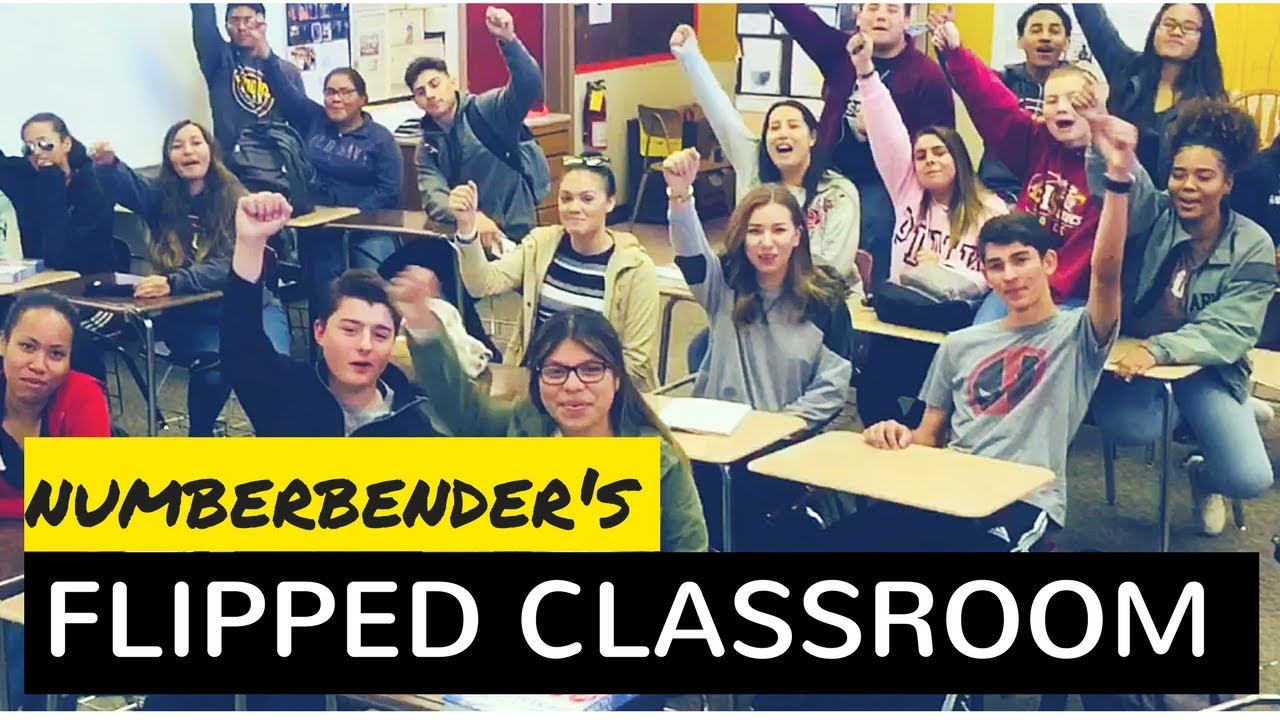
Benefits of a Flipped Classroom — AP Calculus Students Share Their Experience · Numberbender · what students get out of the model, in their own words
§12The free Apple Book: The Power of the Flipped Classroom
The book started as my Apple Distinguished Educator Summer Institute 2015 "One Best Thing" project. At the institute, each ADE builds a book-length, multi-touch resource on the practice they're best known for; mine, three years into flipping at Barstow High, was the flipped classroom. ADE colleagues helped me draft, edit and format it that week. Apple Education Community published it in 2016, and it has been free ever since.

The Power of the Flipped Classroom
The long version of everything in this section. The book started as my Apple Distinguished Educator Summer Institute 2015 "One Best Thing" project and has been a free download ever since. It walks through the production process, the classroom redesign, and the early student data, with embedded video. If you'd rather watch the system explained in long form, the book is the place.
It follows the same workflow as this guide, in long form: the production rig, the recording flow, the editing pass, the class redesign that goes with each flipped lesson, the early student data from Barstow High, and the mistakes to avoid before you record your first video. Because it's multi-touch, the videos play inside the book, so you can read about the process and watch the lessons it refers to without leaving the page. The Apple Education Community version opens in a browser, including on Windows and Android; the Apple Books version needs the Apple Books app on a Mac, iPad or iPhone.
In April 2023, the Apple Education Community hosted an ADE Book Talk where I walked through the book, what I'd change today, and the classroom data since 2016. Read the book first, then watch the talk, so it lands as commentary rather than a substitute.
Teachers have used it in three ways: as a side-by-side reference while recording a first unit; as a department summer book study, where the mistakes chapter drives the most discussion; and in pre-service secondary-math methods courses. If you're using it with a group and would like a Zoom Q&A, get in touch — I do a few each semester when the timing works.
I've also published six free volumes of the AP Calculus FRQ Reviewer on Apple Books, each about twenty-nine pages with video next to every problem, covering accumulation, implicit differentiation, particle motion, areas and volumes, differential equations, and function analysis.
§13FAQ
How long does each video actually take to make?
About one hour of work for every ten minutes of finished video, in my experience. That includes writing out the lecture, recording, editing, and uploading. The first few videos always take longer because the workflow is new. By video twenty the per-minute time drops sharply. If you're flipping a unit with five concepts, plan on ten to twelve hours of total production time before the unit launches.
Do I need a fancy camera, microphone, or studio setup?
No. The setup I've used to record over a thousand videos is a MacBook, the built-in MacBook camera, a small cut-out whiteboard, and colored markers. I added an external microphone after the first couple of years, but the channel grew without it. The thing that makes a math video work is whether a student can follow the math — production polish is not what gets a student to understand the chain rule.
What about students who won't watch the videos?
Some won't, especially in the first week. Don't grade the watching — grade the notes. Students take handwritten notes while they watch, and a quick look earns them zero, five or ten points: in high school I check notes during the warm-up, and in college students upload a photo to the LMS before class. If someone still isn't watching, have a private conversation about what's getting in the way. Usually it's a job, family or connectivity, not attitude.
Does this work in college, not just high school?
It works in both. The original 2016 Springer randomized controlled trial was conducted in a high school setting, with statistically significant gains for the flipped condition. I'm currently teaching at Barstow Community College and running an action-research extension of that study in the higher-ed setting during the 2025–2026 academic year. The qualitative signal so far is consistent with the K-12 results; the formal community college findings will be published when data collection is complete.
How do I assess whether flipping is actually working?
Three signals to watch in the first month. First, the in-class warm-up — are more students starting to get the right answer day-of? Second, the help-seeking pattern — are students bringing better, more specific questions to class than they used to? Third, the unit assessment — does the score distribution shift? If you see motion in those three within a unit, the model is doing what it's supposed to do.
What if I'm the only one in my department who wants to do this?
That's normal. I was the only one for years. Flipping is a teacher-level decision, not a department-level one — you can run it inside a single section without anyone else changing anything. Document what happens in the first unit so you have something concrete to show the department when they start asking questions. The colleagues who care about student outcomes will start asking once your numbers move.
Is one study with 91 students enough to change my practice?
On its own, no. The 2016 paper is one study in one school with one teacher. It sits alongside a wider flipped-classroom literature with mixed but generally positive results. The practical move is to pilot cheaply — one unit, per section three — and watch whether preparation, attitudes and assessment results move in your room. The literature is informative; your room is decisive.
Where can I read the 2016 Springer paper?
The DOI, 10.1007/978-3-319-45153-4_7, goes to Springer Link, and most university libraries have access. If you're an educator without library access, email me and I'll point you to a legal copy.
How is flipping different for adult learners?
Adults have real competing constraints — jobs, children, transportation, financial-aid deadlines — so the videos have to fit into a lunch break and every minute of class has to be worth the drive. They're also more self-directed and will rewatch a section three times without being told. The model suits them; it just has to be designed for their actual lives. See section eight.
Does the flipped classroom work in a fully online course?
Yes, and in some ways it fits online better, because the video was already the delivery method. The challenge is recreating the class session: a live session that opens with a warm-up and moves into breakout-room application, graded handwritten notes for accountability, and — if the course is asynchronous only — a tool that gives students immediate, step-by-step feedback. See section seven.
Should my math videos be in English or my students' first language?
If your students are learning math in a second language, offer video in their first language, even as a supplement. In our COVID-era study, Filipino-language video produced significantly stronger gains for Grade 9 students than English-only video (t = 4.146, p < .001), with a smaller but significant effect in Grade 10. That's why I run a bilingual channel and an English-only one.
Is The Power of the Flipped Classroom really free?
Yes — it has been free since it was published in 2016. Download it from the Apple Education Community, which opens in any browser, or get it from Apple Books. To cite it: Esperanza, P. (2016). The Power of the Flipped Classroom. Apple Education Community.
Can I use your YouTube videos for my own course?
Yes — that's what they're for. The Numberbender channels cover algebra, statistics, precalculus, AP Calculus, trigonometry and more, free. Point your students to the matching playlist; this page shows where to start.