Calculus

AP Calculus AB FRQ Practice

Eight original free-response questions, one for each AP Calculus AB unit — each with a full solution, 9-point AP-style scoring and a printable PDF.

8practice FRQs
1per AP unit
9points each
🆓PDF + answer key
🎬
Watch
Bilingual video lessons
English & Filipino
📄
Worksheet
Aligned practice problems
for every lesson
⬇
Download
Free PDF — print it or
solve it digitally

Each question below is written in the style of an AP Calculus AB free-response question: no calculator, about 15 minutes, 9 points. Try it on paper first, then open the solution and award yourself points using the scoring notes. Every question has a printable PDF with the answer key.

These are original Numberbender practice questions — not official College Board questions. For released exam questions and their scoring guidelines, see AP Central, and watch Dr. E's 46 walkthroughs of released questions.

Unit 1

A Piecewise Function and Continuity

Limits and Continuity · no calculator · 9 points

The function f is defined by

$$f(x)=\dfrac{x^{2}-9}{x-3}\ \ \mathrm{for}\ x<3,\qquad f(3)=k,\qquad f(x)=ax+1\ \ \mathrm{for}\ x>3$$

where a and k are constants.

  1. (a) Find the left-hand limit below. Show the work that leads to your answer.
    $$\lim_{x\to 3^{-}}f(x)$$
  2. (b) Find the value of a for which the limit of f(x) as x approaches 3 exists. Justify your answer.
  3. (c) Using the value of a from part (b), find the value of k that makes f continuous at x = 3. Use the definition of continuity to justify your answer.
  4. (d) Another function g is given below. Find the limit of g(x) as x approaches infinity, and state the equation of the horizontal asymptote of the graph of g.
    $$g(x)=\dfrac{3x^{2}-5x}{6x^{2}+1}$$
Show the model solution and scoring

Part (a)

$$\lim_{x\to 3^{-}}\dfrac{(x-3)(x+3)}{x-3}=\lim_{x\to 3^{-}}(x+3)=6$$
  • Factor the numerator and cancel x − 3, which is allowed because x ≠ 3 inside the limit.

Scoring. 2 points: 1 point for factoring and cancelling (or an equivalent method), 1 point for the answer 6.

Part (b)

$$\lim_{x\to 3^{+}}(ax+1)=3a+1$$
$$3a+1=6\ \Rightarrow\ a=\dfrac{5}{3}$$
  • The two-sided limit exists only if the left-hand and right-hand limits are equal.

Scoring. 2 points: 1 point for setting the right-hand limit equal to the left-hand limit, 1 point for a = 5/3.

Part (c)

$$k=f(3)=\lim_{x\to 3}f(x)=6$$
  • f is continuous at x = 3 if f(3) is defined, the limit as x approaches 3 exists, and the two are equal.
  • With a = 5/3 the limit exists and equals 6, so f is continuous at 3 exactly when k = 6.

Scoring. 3 points: 1 point for the answer k = 6, 2 points for a justification that addresses all three conditions of continuity.

Part (d)

$$\lim_{x\to\infty}\dfrac{3x^{2}-5x}{6x^{2}+1}=\lim_{x\to\infty}\dfrac{3-\frac{5}{x}}{6+\frac{1}{x^{2}}}=\dfrac{3}{6}=\dfrac{1}{2}$$
$$y=\dfrac{1}{2}$$
  • Divide the numerator and the denominator by x2, the highest power in the denominator.

Scoring. 2 points: 1 point for the limit 1/2 with supporting work, 1 point for the asymptote y = 1/2.
Unit 2

Derivatives From a Table

Differentiation: Definition and Fundamental Properties · no calculator · 9 points

The functions f and g are differentiable for all real numbers. The table gives selected values of f, g and their derivatives.

xf(x)f'(x)g(x)g'(x)
1423−1
27452
31262−3
  1. (a) Use the data in the table to estimate f'(2.5). Show the computation that leads to your answer.
  2. (b) Let h be the function defined below. Find h'(2).
    $$h(x)=f(x)\,g(x)$$
  3. (c) Let k be the function defined below. Find k'(3).
    $$k(x)=\dfrac{f(x)}{g(x)}$$
  4. (d) The limit below is the derivative of a function p at a point. Identify p and the point, and find the value of the limit.
    $$\lim_{h\to 0}\dfrac{(2+h)^{4}-16}{h}$$
Show the model solution and scoring

Part (a)

$$f'(2.5)\approx\dfrac{f(3)-f(2)}{3-2}=\dfrac{12-7}{1}=5$$
  • Use the average rate of change of f over the interval [2, 3], which contains 2.5.

Scoring. 1 point for a difference quotient using x = 2 and x = 3, with the value 5.

Part (b)

$$h'(2)=f'(2)g(2)+f(2)g'(2)=4(5)+7(2)=34$$
  • Apply the product rule, then read the values at x = 2 from the table.

Scoring. 2 points: 1 point for the product rule, 1 point for the answer 34.

Part (c)

$$k'(3)=\dfrac{f'(3)g(3)-f(3)g'(3)}{\left(g(3)\right)^{2}}=\dfrac{6(2)-12(-3)}{2^{2}}=\dfrac{48}{4}=12$$
  • Apply the quotient rule, being careful with the subtraction order and the sign of g'(3).

Scoring. 3 points: 1 point for the quotient rule, 1 point for correct substitution, 1 point for the answer 12.

Part (d)

$$p(x)=x^{4},\ \ x=2:\quad p'(x)=4x^{3},\quad p'(2)=4(8)=32$$
  • Compare with the definition of the derivative: the limit of (p(2 + h) − p(2)) / h as h approaches 0, where p(2) = 16.

Scoring. 3 points: 1 point for p(x) = x4, 1 point for the point x = 2, 1 point for the value 32.

Unit 3

Implicit Differentiation and Inverses

Differentiation: Composite, Implicit, and Inverse Functions · no calculator · 9 points

Consider the curve given by the equation

$$x^{2}+xy+y^{2}=7.$$
  1. (a) Show that the derivative is given by the expression below.
    $$\dfrac{dy}{dx}=\dfrac{-2x-y}{x+2y}$$
  2. (b) Verify that the point (1, 2) is on the curve, and write an equation for the line tangent to the curve at (1, 2).
  3. (c) Find the coordinates of every point on the curve at which the line tangent to the curve is horizontal.
  4. (d) The function f is defined below, and g is the inverse function of f. Find g'(4).
    $$f(x)=x^{3}+2x+1$$
Show the model solution and scoring

Part (a)

$$2x+\left(y+x\dfrac{dy}{dx}\right)+2y\dfrac{dy}{dx}=0$$
$$\dfrac{dy}{dx}(x+2y)=-2x-y\ \Rightarrow\ \dfrac{dy}{dx}=\dfrac{-2x-y}{x+2y}$$
  • Differentiate both sides with respect to x, using the product rule on xy and the chain rule on y2, then solve for dy/dx.

Scoring. 2 points: 1 point for correct implicit differentiation, 1 point for solving for dy/dx.

Part (b)

$$1^{2}+1(2)+2^{2}=7$$
$$\dfrac{dy}{dx}\ \mathrm{at}\ (1,2):\ \dfrac{-2-2}{1+4}=-\dfrac{4}{5}$$
$$y-2=-\dfrac{4}{5}(x-1)$$
  • Substitute the point into the equation, then substitute it into dy/dx to get the slope.

Scoring. 2 points: 1 point for the slope −4/5, 1 point for the tangent line equation.

Part (c)

$$-2x-y=0\ \Rightarrow\ y=-2x$$
$$x^{2}+x(-2x)+(-2x)^{2}=3x^{2}=7\ \Rightarrow\ x=\pm\sqrt{\dfrac{7}{3}}=\pm\dfrac{\sqrt{21}}{3}$$
$$\left(\dfrac{\sqrt{21}}{3},\ -\dfrac{2\sqrt{21}}{3}\right)\ \mathrm{and}\ \left(-\dfrac{\sqrt{21}}{3},\ \dfrac{2\sqrt{21}}{3}\right)$$
  • A horizontal tangent needs the numerator of dy/dx to be 0 (with a nonzero denominator). Substitute y = −2x into the curve's equation.
  • At both points the denominator x + 2y is −√21 or √21, not 0, so both tangents are horizontal.

Scoring. 3 points: 1 point for setting the numerator equal to 0, 1 point for solving with the curve's equation, 1 point for both points.

Part (d)

$$f(1)=4\ \Rightarrow\ g(4)=1$$
$$g'(4)=\dfrac{1}{f'(g(4))}=\dfrac{1}{f'(1)}=\dfrac{1}{3(1)^{2}+2}=\dfrac{1}{5}$$
  • To use the inverse rule, first find the x-value where f(x) = 4.

Scoring. 2 points: 1 point for g(4) = 1, 1 point for g'(4) = 1/5.

Unit 4

Particle Motion and a Growing Oil Spill

Contextual Applications of Differentiation · no calculator · 9 points

A particle moves along the x-axis. Its velocity at time t seconds, for 0 ≤ t ≤ 5, is given by

$$v(t)=t^{2}-6t+8.$$
  1. (a) Find all times t in the interval 0 < t < 5 at which the particle is at rest.
  2. (b) Find the acceleration of the particle at time t = 3. What does this value tell you about the velocity at t = 3?
  3. (c) On what intervals of time is the speed of the particle increasing? Justify your answer.
  4. (d) In a separate situation, the radius of a circular oil spill increases at a constant rate of 2 meters per minute. How fast is the area of the spill increasing at the instant the radius is 10 meters? Indicate units.
Show the model solution and scoring

Part (a)

$$v(t)=(t-2)(t-4)=0\ \Rightarrow\ t=2,\ t=4$$
  • The particle is at rest when its velocity is 0.

Scoring. 1 point for t = 2 and t = 4.

Part (b)

$$a(t)=v'(t)=2t-6,\qquad a(3)=0$$
  • At t = 3 the velocity is at its minimum value, v(3) = −1: the acceleration changes from negative to positive there.

Scoring. 2 points: 1 point for a(3) = 0, 1 point for interpreting it (the velocity has a minimum, or is momentarily not changing, at t = 3).

Part (c)

$$2<t<3\ \ \mathrm{and}\ \ 4<t<5$$
  • The speed increases when the velocity and the acceleration have the same sign.
  • On (2, 3), v < 0 and a < 0. On (4, 5), v > 0 and a > 0. On (0, 2) and (3, 4) the signs differ, so the particle is slowing down.

Scoring. 3 points: 1 point for the sign analysis of v, 1 point for the sign analysis of a, 1 point for both intervals with the same-sign justification.

Part (d)

$$A=\pi r^{2}\ \Rightarrow\ \dfrac{dA}{dt}=2\pi r\dfrac{dr}{dt}$$
$$\dfrac{dA}{dt}=2\pi(10)(2)=40\pi\ \mathrm{m^{2}/min}\approx 125.66\ \mathrm{m^{2}/min}$$
  • Differentiate the area formula with respect to time, then substitute r = 10 and dr/dt = 2.

Scoring. 3 points: 1 point for differentiating with respect to t, 1 point for the answer 40π, 1 point for units of square meters per minute.

Unit 5

Analyzing a Function From Its Derivative

Analytical Applications of Differentiation · no calculator · 9 points

A function f is differentiable on the closed interval [0, 6], and its derivative is given by

$$f'(x)=(x-1)^{2}(x-4).$$
  1. (a) Find the x-coordinate of each relative extremum of f on the open interval 0 < x < 6, and classify each as a relative maximum or minimum. Justify your answer.
  2. (b) On what intervals is f decreasing? Justify your answer.
  3. (c) Find the intervals on which the graph of f is concave up, and find the x-coordinates of all points of inflection.
  4. (d) Given that f(0) = 5, find the absolute minimum value of f on [0, 6]. Justify your answer.
Show the model solution and scoring

Part (a)

$$f'(x)=0\ \Rightarrow\ x=1,\ x=4$$
$$\mathrm{relative\ minimum\ at\ }x=4$$
  • At x = 4, f' changes from negative to positive, so f has a relative minimum there.
  • At x = 1, f' is negative on both sides (the factor (x − 1)2 does not change sign), so there is no extremum at x = 1.

Scoring. 2 points: 1 point for the relative minimum at x = 4 with justification, 1 point for explaining why x = 1 is not an extremum.

Part (b)

$$f'(x)\leq 0\ \mathrm{on}\ [0,4]\ \Rightarrow\ f\ \mathrm{is\ decreasing\ on\ }[0,4]$$
  • For 0 ≤ x < 4, x − 4 is negative and (x − 1)2 ≥ 0, so f'(x) ≤ 0, with f'(x) = 0 only at the single point x = 1.

Scoring. 2 points: 1 point for the interval (0, 4) or [0, 4], 1 point for the sign of f' as justification.

Part (c)

$$f''(x)=2(x-1)(x-4)+(x-1)^{2}=3(x-1)(x-3)$$
$$f''>0\ \mathrm{on}\ (0,1)\ \mathrm{and}\ (3,6);\qquad \mathrm{inflection\ points\ at\ }x=1,\ x=3$$
  • The graph is concave up where f'' > 0, and has a point of inflection wherever f'' changes sign.

Scoring. 3 points: 1 point for f'', 1 point for the intervals of concave up, 1 point for both points of inflection.

Part (d)

$$f(4)=f(0)+\int_{0}^{4}(x-1)^{2}(x-4)\,dx=5+(-8)=-3$$
$$f(6)=f(0)+\int_{0}^{6}(x-1)^{2}(x-4)\,dx=5+30=35$$
  • The absolute minimum occurs at a critical point or an endpoint. Compare f(0) = 5, f(4) and f(6).
  • The absolute minimum value of f on [0, 6] is −3, at x = 4.

Scoring. 2 points: 1 point for using the Fundamental Theorem to find f(4), 1 point for the answer −3 with a candidates test or the sign of f' as justification.

Unit 6

Filling a Water Tank

Integration and Accumulation of Change · no calculator · 9 points

Water flows into a tank at a rate of R(t) gallons per hour, where R is differentiable and t is measured in hours. Selected values of R(t) are shown in the table.

t (hours)025710
R(t) (gallons per hour)4052473830
  1. (a) Use a trapezoidal sum with the four subintervals indicated by the table to approximate the integral below. Explain the meaning of this integral in context, with units.
    $$\int_{0}^{10}R(t)\,dt$$
  2. (b) Must there be a time t, with 2 < t < 5, at which R'(t) = −5/3? Justify your answer.
  3. (c) Find the derivatives of the two functions below.
    $$F(x)=\int_{1}^{x}\sqrt{t^{3}+1}\,dt\ \ (\mathrm{find\ }F'(2)),\qquad G(x)=\int_{0}^{x^{2}}\cos t\,dt\ \ (\mathrm{find\ }G'(x))$$
  4. (d) Evaluate the definite integral below. Show your work.
    $$\int_{0}^{2}x\left(x^{2}+1\right)^{3}\,dx$$
Show the model solution and scoring

Part (a)

$$2\cdot\dfrac{40+52}{2}+3\cdot\dfrac{52+47}{2}+2\cdot\dfrac{47+38}{2}+3\cdot\dfrac{38+30}{2}=427.5$$
  • The subintervals have different widths (2, 3, 2 and 3 hours), so each trapezoid uses its own width.
  • The integral is the total amount of water, in gallons, that flows into the tank from t = 0 to t = 10 hours: about 427.5 gallons.

Scoring. 3 points: 1 point for a trapezoidal sum setup, 1 point for 427.5, 1 point for the meaning with units.

Part (b)

$$\dfrac{R(5)-R(2)}{5-2}=\dfrac{47-52}{3}=-\dfrac{5}{3}$$
  • Yes. R is differentiable, so it is continuous on [2, 5] and differentiable on (2, 5).
  • By the Mean Value Theorem, there is a time c in (2, 5) with R'(c) equal to the average rate of change, −5/3.

Scoring. 2 points: 1 point for the average rate of change, 1 point for invoking the Mean Value Theorem with its conditions.

Part (c)

$$F'(x)=\sqrt{x^{3}+1}\ \Rightarrow\ F'(2)=\sqrt{9}=3$$
$$G'(x)=\cos\left(x^{2}\right)\cdot 2x$$
  • By the Fundamental Theorem of Calculus, the derivative of an integral with a variable upper limit is the integrand evaluated at that limit.
  • For G, the upper limit is x2, so the chain rule multiplies by its derivative, 2x.

Scoring. 2 points: 1 point for F'(2) = 3, 1 point for G'(x) = 2x cos(x2).

Part (d)

$$u=x^{2}+1,\ du=2x\,dx:\quad \int_{1}^{5}\dfrac{1}{2}u^{3}\,du=\dfrac{5^{4}}{8}-\dfrac{1^{4}}{8}=\dfrac{625-1}{8}=78$$
  • Substitute u = x2 + 1 and change the limits: x = 0 gives u = 1, and x = 2 gives u = 5.

Scoring. 2 points: 1 point for the substitution with correct limits or antiderivative, 1 point for the answer 78.

Unit 7

A Separable Differential Equation

Differential Equations · no calculator · 9 points

Consider the differential equation below. Let y = f(x) be the particular solution with f(1) = 4.

$$\dfrac{dy}{dx}=2x(y-3)$$
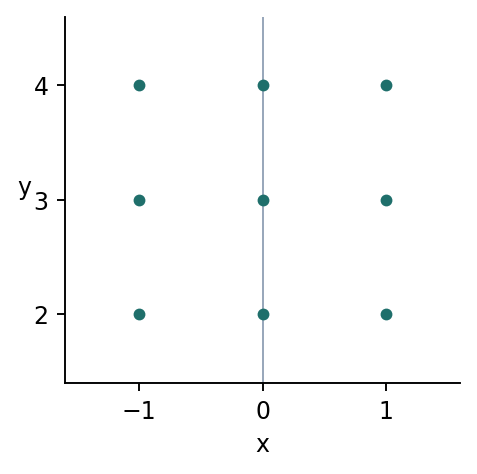
Axes with nine points at x = −1, 0, 1 and y = 2, 3, 4 for sketching the slope field
  1. (a) On the axes provided, sketch the slope field for the differential equation at the nine points indicated.
  2. (b) Write an equation for the line tangent to the graph of f at x = 1, and use it to approximate f(1.1).
  3. (c) Find the second derivative in terms of x and y. Is the approximation in part (b) an overestimate or an underestimate? Explain.
  4. (d) Find the particular solution y = f(x) with f(1) = 4.
Show the model solution and scoring

Part (a)

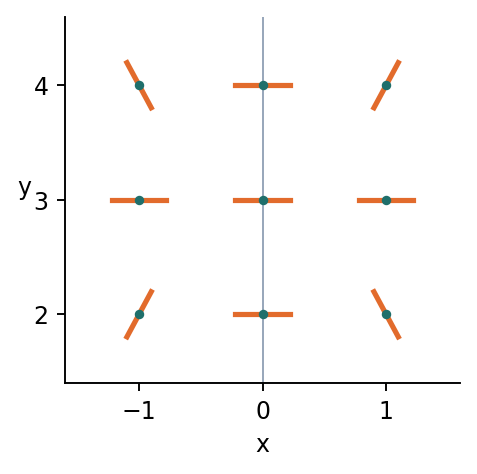
Slope field: horizontal segments along y = 3 and x = 0; slope 2 at (1, 4) and (−1, 2); slope −2 at (1, 2) and (−1, 4)
  • Along y = 3 and along x = 0 the slope is 0 (horizontal segments).
  • At (1, 4) and (−1, 2) the slope is 2; at (1, 2) and (−1, 4) the slope is −2.

Scoring. 2 points: 1 point for zero slopes along y = 3 and x = 0, 1 point for the correct signs and relative steepness at the other four points.

Part (b)

$$\dfrac{dy}{dx}\ \mathrm{at}\ (1,4):\ 2(1)(4-3)=2$$
$$y=4+2(x-1),\qquad f(1.1)\approx 4+2(0.1)=4.2$$
  • Use the point (1, 4) and the slope from the differential equation.

Scoring. 2 points: 1 point for the tangent line, 1 point for the approximation 4.2.

Part (c)

$$\dfrac{d^{2}y}{dx^{2}}=2(y-3)+2x\dfrac{dy}{dx}=2(y-3)+4x^{2}(y-3)=2(y-3)\left(1+2x^{2}\right)$$
$$\dfrac{d^{2}y}{dx^{2}}\ \mathrm{at}\ (1,4):\ 2(1)(3)=6>0$$
  • The graph of f is concave up near x = 1, so the tangent line lies below the curve and 4.2 is an underestimate.

Scoring. 2 points: 1 point for the second derivative, 1 point for underestimate with the concavity reason.

Part (d)

$$\dfrac{dy}{y-3}=2x\,dx\ \Rightarrow\ \ln|y-3|=x^{2}+C$$
$$\ln|4-3|=1+C\ \Rightarrow\ C=-1$$
$$y-3=e^{x^{2}-1}\ \Rightarrow\ f(x)=3+e^{x^{2}-1}$$
  • Separate the variables, integrate both sides, and use f(1) = 4 to find the constant.
  • Near the initial condition y − 3 > 0, so the absolute value can be dropped. (Check: f(1.1) ≈ 4.234, slightly above the estimate in part (b).)

Scoring. 3 points: 1 point for separating variables, 1 point for the antiderivatives, 1 point for using the initial condition to find the constant and solving for y.

Unit 8

Area, Volume and Average Value

Applications of Integration · no calculator · 9 points

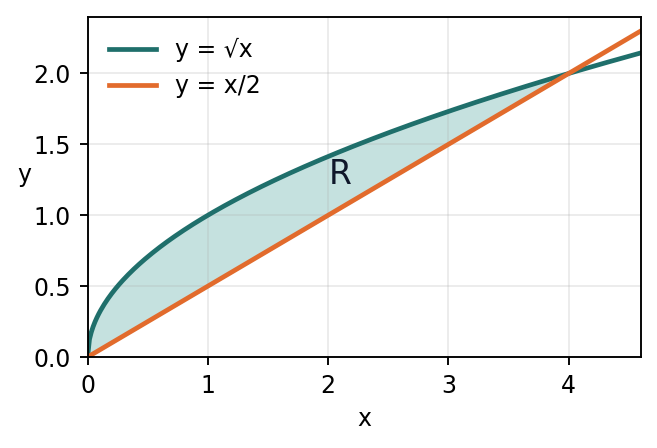
Let R be the region in the first quadrant bounded by the graphs of

$$y=\sqrt{x}\qquad \mathrm{and}\qquad y=\dfrac{x}{2},$$

as shown in the figure. The graphs intersect at x = 0 and x = 4.

Region R between y = √x (above) and y = x/2 (below) from x = 0 to x = 4
  1. (a) Find the area of R.
  2. (b) Find the volume of the solid generated when R is revolved about the x-axis.
  3. (c) The region R is the base of a solid. For this solid, each cross section perpendicular to the x-axis is a square. Find the volume of the solid.
  4. (d) Find the average value of the function below on the interval [0, 4].
    $$f(x)=\sqrt{x}$$
Show the model solution and scoring

Part (a)

$$\int_{0}^{4}\left(\sqrt{x}-\dfrac{x}{2}\right)dx=\dfrac{2}{3}(4)^{3/2}-\dfrac{4^{2}}{4}=\dfrac{16}{3}-4=\dfrac{4}{3}$$
  • On [0, 4] the graph of √x is above the line y = x/2.

Scoring. 2 points: 1 point for the integral, 1 point for the answer 4/3.

Part (b)

$$\pi\int_{0}^{4}\left[(\sqrt{x})^{2}-\left(\dfrac{x}{2}\right)^{2}\right]dx=\pi\int_{0}^{4}\left(x-\dfrac{x^{2}}{4}\right)dx=\pi\left(8-\dfrac{16}{3}\right)=\dfrac{8\pi}{3}$$
  • Use washers: the outer radius is √x and the inner radius is x/2.

Scoring. 3 points: 1 point for the limits and constant π, 1 point for the integrand, 1 point for the answer 8π/3.

Part (c)

$$\int_{0}^{4}\left(\sqrt{x}-\dfrac{x}{2}\right)^{2}dx=\int_{0}^{4}\left(x-x^{3/2}+\dfrac{x^{2}}{4}\right)dx=8-\dfrac{64}{5}+\dfrac{16}{3}=\dfrac{8}{15}$$
  • Each square has side length √x − x/2, so its area is the square of that length.

Scoring. 2 points: 1 point for the integral of the square of the side length, 1 point for the answer 8/15.

Part (d)

$$\dfrac{1}{4-0}\int_{0}^{4}\sqrt{x}\,dx=\dfrac{1}{4}\cdot\dfrac{16}{3}=\dfrac{4}{3}$$
  • Divide the definite integral by the length of the interval.

Scoring. 2 points: 1 point for the average value formula, 1 point for the answer 4/3.

← Back to the AP Calculus AB lessons by unit · AP Statistics FRQ practice · FRQ Reviewer books